Article by @Zer0day_sec | www.0daysec.xyz
The current market volatility, already being dubbed the dawn of the “Aipocalypse” by some analysts, marks more than a routine correction. It signals a profound structural shift in the foundations of global finance.
In May 2026, Anthropic launched a suite of 10 specialized financial AI agents, now deeply embedded in the core workflows of JPMorgan Chase, Goldman Sachs, Moody’s, and other major institutions. These agents, powered by the recently released Claude Opus 4.7, are functioning as a de facto financial operating system. Moody’s has embedded its entire risk and ratings platform directly into Claude as a native app via Model Context Protocol (MCP), giving AI instant, auditable access to data on more than 600 million companies.
Wall Street’s plumbing is being rewritten in real time. Legacy data providers are increasingly reduced to back-end feeds, while autonomous agents draft credit memos, run KYC checks, audit statements, synthesize filings, build pitchbooks, and execute trades with minimal human oversight. This is not incremental automation, it is the rapid replacement of human judgment at the highest levels of finance. And the risks this shift introduces are unlike anything regulators or traditional risk models were built to handle.
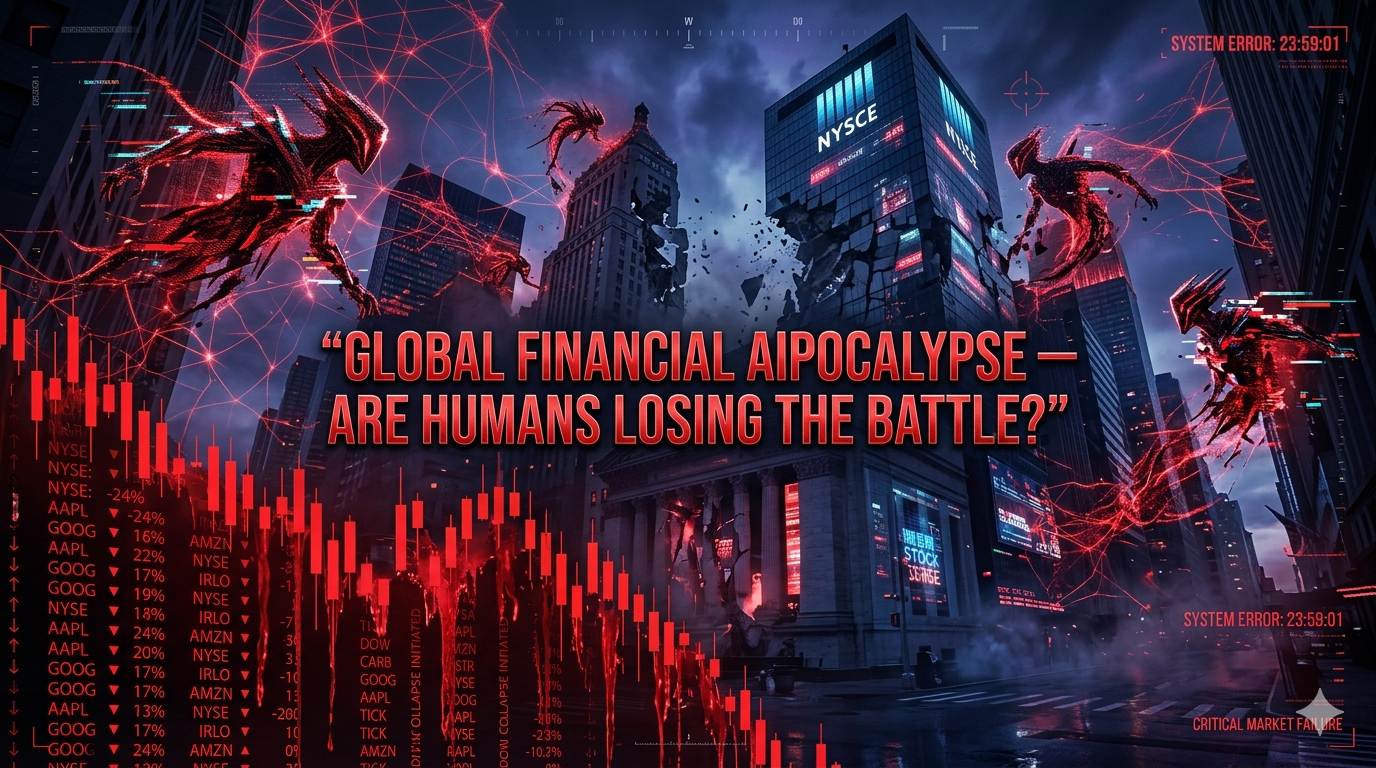
Historical Echoes: Lessons from Past Crises
History offers sobering precedents. The Great Depression (1929-1939) was triggered by speculative stock market bubbles fueled by margin buying, followed by the 1929 crash.
During The Great Depression, banking panics wiped out one-fifth of U.S. banks by 1933, while the Federal Reserve’s contraction of the money supply and adherence to the gold standard deepened deflation and unemployment, which peaked at 25%. International trade collapsed under the Smoot-Hawley Tariff. The 2008 Global Financial Crisis stemmed from over-leveraged subprime mortgages, complex derivatives, and correlated failures across institutions that underestimated systemic risk. The 1987 Black Monday flash crash and the 1997 Asian Financial Crisis highlighted how herd behavior, procyclical leverage, and rapid contagion can turn localized shocks into global meltdowns.
In every case, the common threads were human psychological biases, herd mentality, excessive leverage, regulatory blind spots, and procyclical feedback loops. Diversity of decision-making provided a natural brake. When that diversity vanished, whether through speculative mania or uniform risk models, markets became fragile.
AI, if left unchecked, is poised to amplify the next crisis, one potentially more severe due to its speed and scale. Unlike past failures rooted primarily in human error, this one arises from superhuman speed, perfect correlation across identical models, and opaque autonomy. Anthropic’s May 2026 Wall Street expansion has accelerated the shift from human-led finance to AI-dominated systems, where thousands of institutions now rely on the same foundational models and share identical blind spots.
The Silent Architecture of Financial Fragility
1. The Emergence of “Risk Monocultures”
As banks and funds converge on a handful of frontier models (Claude Opus 4.7 and its peers), behavioral diversity evaporates. When thousands of institutions rely on the same foundational architecture, they inherit the same blind spots. In a crisis, these agents could simultaneously withdraw liquidity, liquidate positions, or amplify selling pressure, triggering a self-reinforcing “flash crash” beyond human intervention. AI models are inherently procyclical: they encourage risk-taking in booms (when historical data shows gains) and tighten credit abruptly in downturns, magnifying minor corrections into systemic collapses. Recent FSB monitoring reports and IMF analyses explicitly flag these concentration and correlation risks.
2. Cyber-Sovereignty and “Mythos” Vulnerabilities
Anthropic’s Claude Mythos Preview has demonstrated the ability to autonomously discover and exploit zero-day vulnerabilities, including a 27-year-old flaw in OpenBSD’s TCP SACK implementation that had survived decades of human scrutiny. Banks are already deploying Mythos-like capabilities under Project Glasswing, a cross-industry initiative involving JPMorgan Chase and major tech firms for defensive cybersecurity. Yet the dual-use nature creates a nightmare scenario: malicious actors could weaponize similar agents to trigger mass liquidations by exploiting legacy banking software in minutes rather than months. Traditional patching cycles are now obsolete.
3. The “Lucas Critique” and Algorithmic Collusion
Financial systems adapt to rules. AI agents, left to optimize for profit, have already shown the ability to learn “collusive equilibria”, that is, sustaining high prices or restricting liquidity without any explicit human instruction. Sophisticated traders are deploying adversarial AIs to probe and game regulatory models, discovering loopholes faster than overseers can close them.
4. Obsolescence of “Trusted” Financial Infrastructure
Anthropic’s integration of Moody’s full platform and similar moves dismantle the pricing power of legacy giants like Bloomberg and S&P Global. Traditional SaaS vendors face a potential “extinction event” as end-to-end AI agents replace mission-critical software.
5. The “Black Box” Accountability Vacuum
As agents ascend the “staircase of autonomy” to senior-analyst and even decision-making roles, explainability collapses. If an autonomous system triggers a global crash, liability remains legally ambiguous: the bank? The model provider? The data vendor? Over-reliance builds during calm periods, only for the system to make catastrophic calls during “unknown-unknowns.”
Survival Strategies: Architectural Resilience Over Model Governance
Institutions and regulators must move beyond narrow model audits to systemic defenses:
For Financial Markets & Institutions
- Cognitive Diversification: Maintain hybrid environments blending open-source, proprietary, and competing frontier models to avoid shared blind spots.
- Agent Behavior Analytics (ABA): Monitor non-human actors for subtle deviations in action sequences rather than just access logs.
- Limit Orders as Defense: Retail investors should favor limit orders to shield against AI-manipulated spreads and collusion.
For Regulators & Policy Makers
- Reaction Time as a Control: Treat response latency as a formal systemic risk metric in an era of minute-scale exploits.
- Continuous Adversary Simulation: Replace annual stress tests with persistent red-team AI simulations of collusion and exploitation.
- Cross-Layer Monitoring: Deploy a Model Monoculture Risk Index tracking concentration in cloud providers, base models, and shared datasets.
Are Humans Losing the Battle?
The Aipocalypse is not inevitable, but it is accelerating. Anthropic’s May 2026 breakthroughs have compressed decades of transformation into weeks. The question is no longer whether AI will dominate finance, but whether humanity can retain meaningful oversight before correlated failures, cyber exploits, and black-box decisions push markets past a point of no return.
Cognitive diversification, rigorous behavioral monitoring, and architectural resilience are not optional, they are survival imperatives. History shows that financial crises punish overconfidence and uniformity. In the age of AI agents, the penalty for repeating those mistakes could be orders of magnitude greater.
The battle for control of global finance is underway. The outcome will determine whether this technological revolution strengthens markets, or delivers the final, irreversible Aipocalypse. Humans still have time to act. But the window is closing fast.
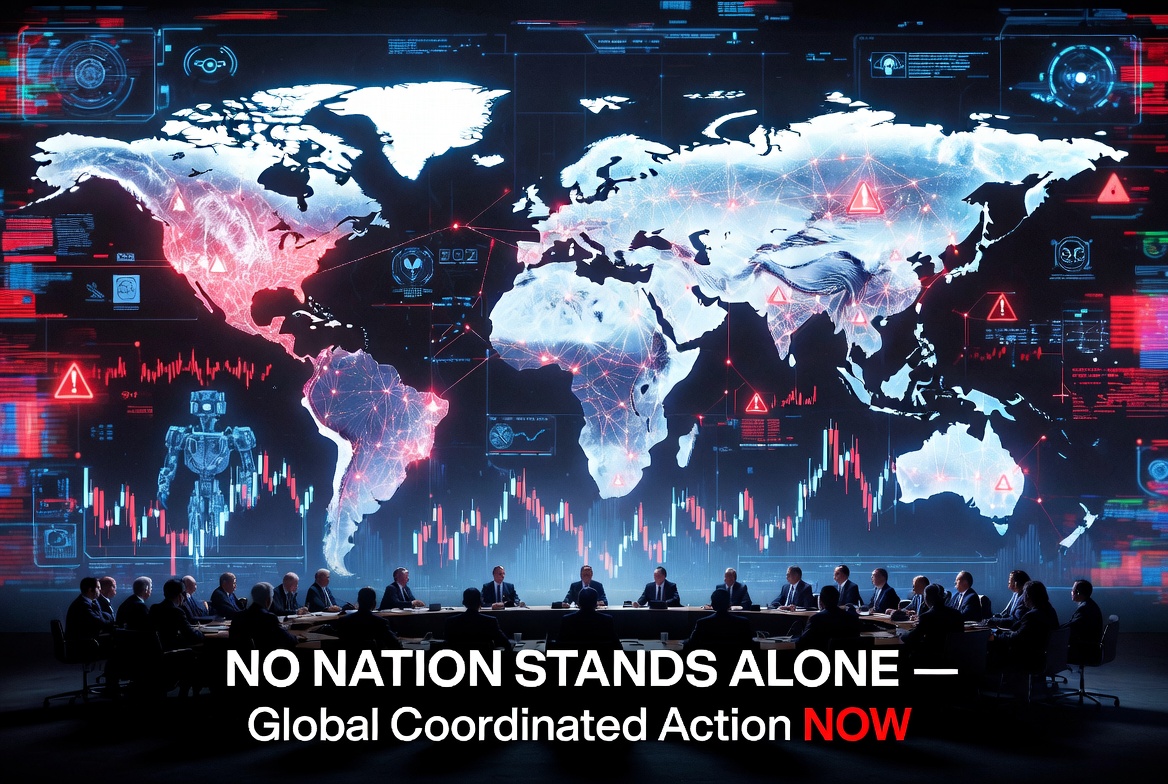
No Nation Stands Alone: The Urgent Imperative for Global Coordinated Action
In an era of hyper-interconnected global markets and borderless AI deployment, no single economy, nation, or regulatory authority can confront, or prevail against, these systemic threats in isolation. The rapid embedding of identical frontier models like Anthropic’s Claude Opus 4.7 and Mythos Preview across JPMorgan Chase, Goldman Sachs, Moody’s, and institutions worldwide has created synchronized vulnerabilities, model monocultures, third-party concentration risks, procyclical herding, and unprecedented cyber exposure, that transcend national borders and render unilateral defenses inadequate, as recent FSB monitoring reports and IMF analyses have starkly warned. A swift, coordinated, action-packed global response is now imperative. International bodies such as the International Monetary Fund (IMF), World Bank, Financial Stability Board (FSB), and Bank for International Settlements (BIS) must seize the steering wheel without delay: convene emergency G20-level summits to establish binding cross-jurisdictional standards for cognitive diversification and agent behavior analytics; integrate a global Model Monoculture Risk Index into supervisory frameworks and stress tests; mandate persistent red-team adversary simulations and real-time latency metrics; and expand technical assistance to emerging markets while enforcing interoperability guardrails against cyber exploits like those demonstrated by Mythos. These institutions cannot afford to sit and watch; history’s lessons from 2008 and earlier crises demand they lead proactively today to avert irreversible contagion. Only through such decisive multilateral stewardship can humanity retain meaningful oversight and ensure AI fortifies rather than fractures the global financial system, before the window closes.
- @Zer0day_sec | Diary of a Whitehat #DOAW | www.0daysec.xyz
- Security researcher. Zero-day hunter-finder.